Woven Label Fold Guide: End, Center, Miter and Loop Folds
Short answer: The fold decides how a woven label sews into the garment and how its edges feel. End fold suits custom woven neck labels, center (loop) fold suits side seams and hem tabs, miter fold (the same fold is spelled mitre in UK English) suits sleeve and hem branding, and straight cut suits fully sewn-down labels. Specify the finished size and the fold — the factory calculates the cut size.
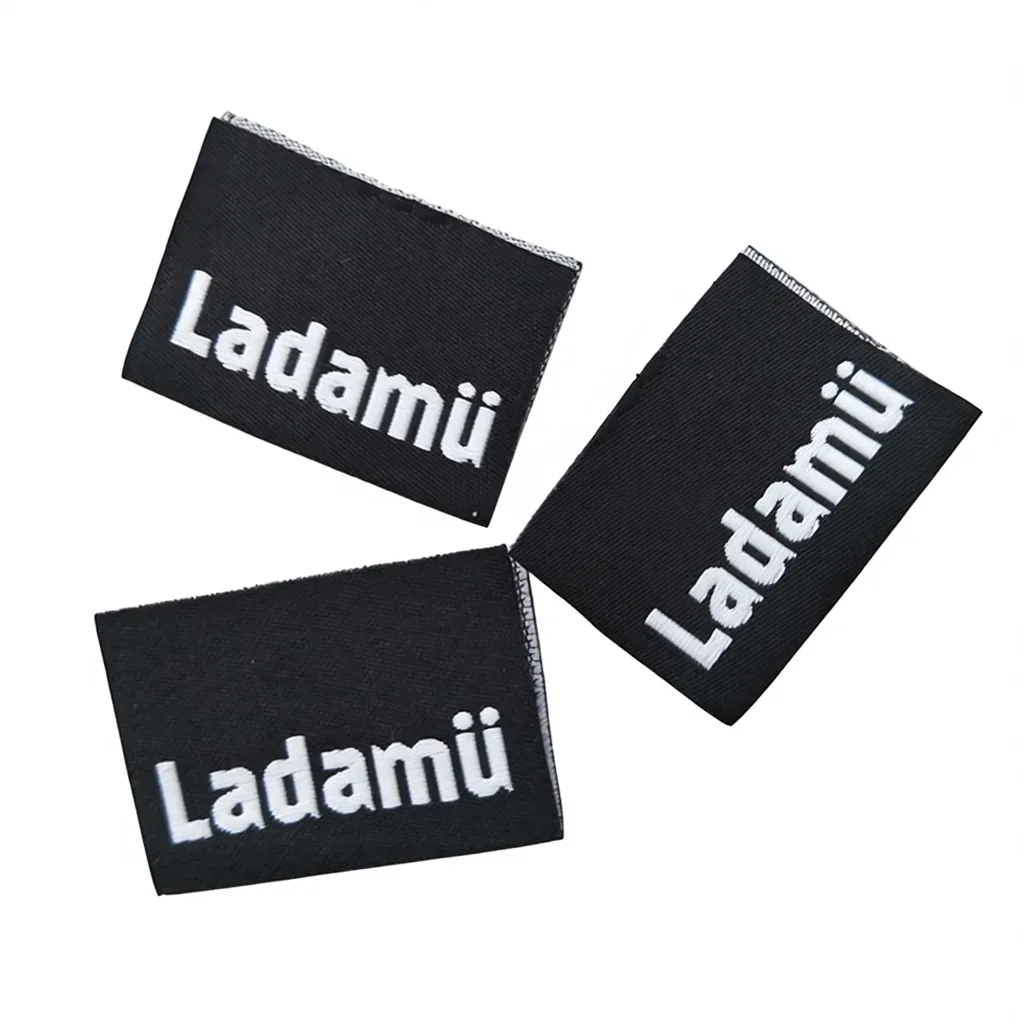
Why the fold is a real decision
A woven label leaves the loom as a flat strip. The fold turns that strip into a sewable component: it hides cut edges, creates sewing allowances and decides which edges touch skin. Two labels with identical artwork but different folds behave differently on the sewing line and feel different in the collar — which is why the fold belongs in the RFQ, not as an afterthought.
The six folds at a glance
| Fold | What it is | Best for |
|---|---|---|
| Straight cut | Flat label, no fold; edges heat-sealed | Labels sewn down on all sides: outerwear, bags, packaging |
| End fold | Left and right ends folded behind | Neck labels sewn top and bottom — the classic brand label |
| Center / loop fold | Folded in half to form a loop | Side seams, hem tabs, small flag labels showing both sides |
| Miter fold also “mitre fold” | Ends folded up at an angle | Sleeve and hem placement where the label hangs from one seam |
| Manhattan fold | Top folded over, ends folded back | Neck labels that hide all raw edges behind the label face |
| Book fold | Folded like a booklet at the top | Combining brand face with size or care data inside |
Any of these folds on your own labels — quoted from $0.20/pc at MOQ 50. Send the artwork and construction suggestions come back free.
Get a QuoteChoosing by garment position
- Neck / collar — end fold or Manhattan fold; the folded ends give the sewing machine clean anchor points.
- Side seam — center fold, caught in the seam as a small flag; both faces are visible, so plan front and back artwork.
- Hem and sleeve — miter fold or center fold, depending on whether the label hangs or lies flat.
- Bags, hats and hard goods — straight cut, sewn or bonded on all edges.
What the fold means for your artwork
Before you send files, check how many faces the fold actually shows. Designing a back face that ends up hidden is wasted work — and forgetting one that turns out to be visible costs a revision round.
| Fold | Faces to design | Why |
|---|---|---|
| Straight cut | 1 (front) | No fold, so nothing is turned behind; the back is covered where the label is sewn or bonded |
| End fold | 1 (front) | The two folded ends sit behind the label face and stay hidden |
| Center / loop fold | 2 (front + back) | The loop shows both faces as a small flag, so both need artwork |
| Miter fold | 1 (front) | The ends angle up behind the face and are not visible |
| Manhattan fold | 1 (front) | Top and ends fold behind the face so all raw edges disappear |
| Book fold | 2 (brand outside, data inside) | The booklet leaves an inner face readable for size or care content |
If the count is unclear for your application, send the front face and say where the label sits — the proof drawing comes back showing every face that will be visible.
Finished size vs cut size
Always specify the finished size — the visible label after folding — plus the fold type. The factory adds the fold allowance to calculate the cut size. A 60 x 15 mm end-fold neck label is woven wider than 60 mm; if you specify cut size by mistake, the visible label comes out smaller than the design. When in doubt, say "finished size" explicitly in the RFQ and check the proof drawing.
FAQ
Which fold is standard for neck labels?
End fold is the most common: the folded ends hide raw edges and give clean sew lines top and bottom. Manhattan fold is the step up when all edges must disappear.
What is a center fold label used for?
Side seams and hem tabs. The label is folded into a loop and caught in the seam, showing a small flag with two printable faces.
Do different folds cost differently?
Folding is a production step, so the difference exists but is modest; the quote states the price per construction so you can compare directly.
Is it miter fold or mitre fold?
Same fold. “Miter” is the US spelling and “mitre” the UK one, so both appear on spec sheets and RFQs — the construction, the fold allowance and the price are identical.
Should I send finished size or cut size?
Finished size. The factory calculates the cut size from the fold type, and the proof drawing shows both before production.
Related reading: Custom woven labels · Custom care labels · How to order · Woven label size guide · Artwork preparation guide
Turn the guide into a quote
Send artwork, quantity and application — we answer with real options, not a form letter.