Artwork Guide for Labels and Patches: Files, Text, Color
Short answer: Send vector artwork (AI, PDF, SVG, EPS or CDR) with fonts converted to outlines; clear PNG or JPG works for review and redraw. Keep text sized to the construction — woven holds the smallest text, embroidery needs bolder letters, chenille takes shapes only — and expect gradients to be split into solid color zones on the proof.
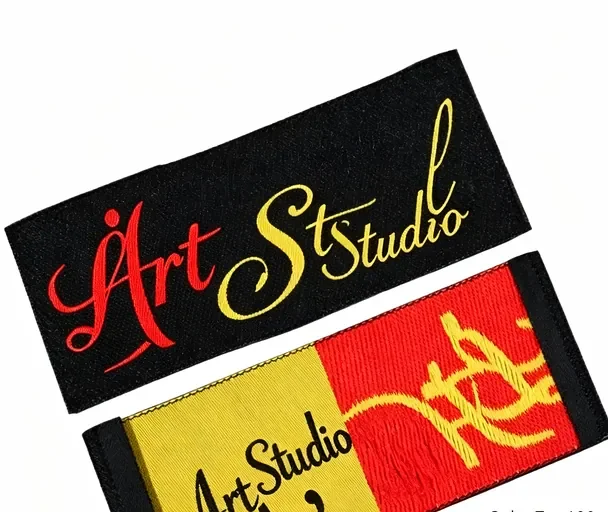
Files that speed up your quote
- Best: vector — AI, PDF, SVG, EPS or CDR, with text converted to outlines/curves.
- Workable: high-resolution PNG or JPG on a clean background; we redraw it for production and you approve the redraw.
- Slowest: a photo of a printed garment or a screenshot from a lookbook — still usable, but expect an extra proof round.
Send the artwork as its own file, not embedded in a tech pack page; and if brand colors matter, include Pantone references rather than screen colors.
Minimum text size by construction
| Construction | Small text tolerance | Rule of thumb |
|---|---|---|
| Woven (damask) | Best in class | Small text survives; hairlines confirmed on the proof |
| Woven patch | Very good | Thin lines and small letters stay legible |
| Embroidery | Limited | Keep letters bold — roughly 4 mm height and up as a starting point |
| Chenille | None | Bold shapes and letters only; no fine detail |
| Leather emboss | Limited | Fine text closes up; laser engraving holds detail better |
| PVC | Good | Crisp molded lines; gradients split into layers |
These are starting points, not lab values — the proof shows exactly how your artwork behaves in the chosen construction before anything is produced.
Pricing this for a real order? Send the artwork — construction suggestions and tiered pricing come back free.
Get a QuoteColor: how yarn differs from screens
Yarn, thread and PVC are physical materials with color libraries, not RGB sliders. Expect three things: colors are matched to the nearest yarn/thread shade (Pantone references help); gradients are split into solid zones; and the number of colors affects the construction and sometimes the price. Approve color on the proof — and for critical brand colors, on a physical sample — rather than on a phone screen.
What happens after you hit send
The sequence at SAIM Label: we review the artwork against the chosen construction, flag anything that will not reproduce (too-small text, gradient zones, eyelet clashes on keychains), and send a production proof showing final size, colors and construction details. Nothing is woven, stitched or molded until you approve that proof — which is why a rough first file is fine to start the conversation.
FAQ
I only have a JPG logo - can I still order?
Yes. A clear JPG or PNG is enough to start: we redraw it as vector for production and you approve the redraw before anything runs.
How many colors can a woven label have?
It depends on the weave and design; thread colors are counted and confirmed at the quote. Send the artwork and the answer comes back with the price.
Can you reproduce gradients?
Gradients are split into solid color zones for woven, embroidered and PVC constructions. The split is shown on the proof for approval.
Do I need to buy a font license?
Convert text to outlines/curves before sending and the font file itself is not needed. If you cannot, name the font and we redraw.
Related reading: How to order · Woven vs embroidered patches · Request a quote · Custom label pricing guide · Woven label size guide · Custom patches for hats & caps · Fold types and their cut allowance
Turn the guide into a quote
Send artwork, quantity and application — we answer with real options, not a form letter.