Woven vs Embroidered Patches: Which Should You Order?
Short answer: the difference is construction. A woven patch has your artwork woven into the fabric as interlaced yarn, so small text and thin lines stay sharp. An embroidered patch has thread stitched on top of a twill base, so it has raised, tactile texture but small letters close up. Choose woven when detail matters more than texture, embroidery when texture is the point. At B2B volumes the prices overlap; the real decision is detail versus texture. Here the question is written woven-first, but embroidered vs woven patches is the same comparison, and the answer does not change.
Quick answer: which one should you order?
If you only read one part of this page, read this. The rest of the guide explains the reasoning behind it.
| If your artwork or product needs… | Order | Because |
|---|---|---|
| Small text, a web address or a slogan that must stay readable | Woven | Woven holds letters just a few millimetres tall; embroidery thread fills small letters in |
| Raised, tactile texture — the feel is the point | Embroidered | Stitched thread sits proud of the base fabric instead of lying flat |
| Multi-element crests and complex artwork | Woven | Fine shapes stay sharp as interlaced yarn instead of blurring |
| Bold logos, mascots and strong outlines | Embroidered | Thick outlines read cleanly when they are stitched |
| A hat front panel that carries a wordmark | Woven | The panel is small, so fine lettering has to stay legible at 6–8 cm wide |
| A uniform or club badge that should look official | Embroidered | The raised badge look reads as issued kit |
| Fine text and a raised edge in the same patch | Hybrid | A woven centre panel with an embroidered border — see the hybrid option |
The rule of thumb: look at the smallest element in your artwork. If it has to stay readable — a URL, a registration line, a fine ring of text — order woven. If the raised texture is what you are buying, order embroidery. Order minimum and lead time are the same either way (50 pcs per design, 10–12 days), so this choice costs you nothing in scheduling.
Both constructions are made in the same factory here, so a single RFQ can price them against each other: send one artwork and get both quoted.
The construction difference
A woven patch is made like fabric: colored polyester yarns interlace on a computer loom, and your artwork is the weave. An embroidered patch starts with a base fabric (twill, usually) and a machine stitches thread on top of it. Everything else — edges, backings, shapes — follows from that one difference.
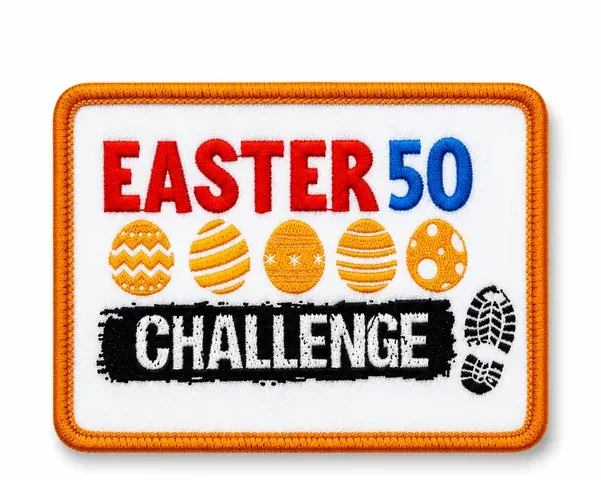
Because woven yarn sits flat, a woven patch can hold letters just a few millimeters tall. Because embroidery thread has physical thickness, small type closes up — but that same thickness is what gives embroidery its raised, premium hand feel.
Side-by-side comparison
This is the woven patch vs embroidered patch decision in one view. The same table answers it whether you are choosing for a single order or rolling woven patches vs embroidered patches out across a product line. It reads the same way round if you searched embroidered vs woven patches instead — the comparison is symmetric, only the column order changes. The first three rows decide most orders.
| Factor | Woven patch | Embroidered patch |
|---|---|---|
| Small text & thin lines | Excellent — readable down to very small type | Limited — thread thickness closes small letters |
| Texture | Flat, smooth, fabric-like | Raised, tactile, classic badge feel |
| Gradients & detail | Good when simplified into color blocks | Poor — best with bold, solid shapes |
| 3D effects | Not available | 3D puff and chenille-style textures |
| Weight on garment | Lighter and thinner | Heavier, stiffer at high stitch coverage |
| Typical look | Modern streetwear, tech, detailed crests | Varsity, military-style, clubs, caps |
| Cost driver | Size and quantity | Stitch count and coverage |
| Smallest lettering | Holds fine type and thin strokes | Needs larger lettering — thread fills small letters |
| Edges & backings | Same menu for both: merrow, laser or heat cut; sew-on, iron-on, hook-and-loop | |
| Order minimum | Same for both: 50 pcs per design | |
| Production lead time | Same for both: 10–12 days | |
When woven wins
- Logos with small text — brand names, URLs, slogans under the mark.
- Complex crests — multi-element artwork that embroidery would blur.
- Hat front panels where fine lettering must stay clean at 6–8 cm wide.
- Lightweight garments — the patch should not deform thin fabric.
When embroidery wins
- Bold, simple logos — letters, mascots, shields with strong outlines.
- Uniforms and clubs — the raised badge look reads as official.
- Caps needing 3D puff — foam-backed embroidery pops on curved panels.
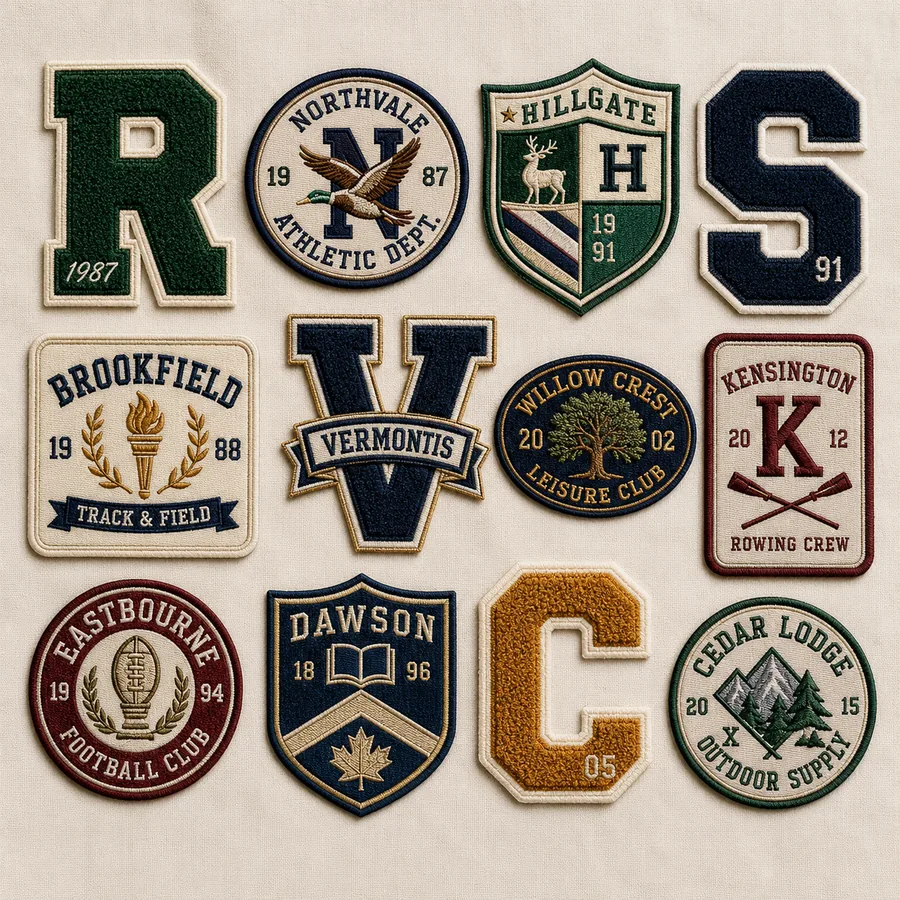
- Varsity programs — chenille-style lettering for jackets and hoodies.
Not sure? Send one artwork, get both constructions quoted.
Compare in one RFQWhere each one hits its limit
Both constructions have a point where the artwork stops working, and knowing it before you send files saves a revision cycle.
- Woven, at the fine end. Woven holds lettering and hairlines that embroidery cannot, because there is no thread height to close the gaps. Where it runs out is soft colour: a photograph or a smooth gradient has to be simplified into solid colour blocks, and every extra colour is a separate weaving decision rather than a free choice.
- Embroidered, at the small end. Thread has physical thickness. Lettering has a minimum size before the stitches merge together, and very fine lines are usually thickened or dropped when the artwork is digitised. Bold shapes, heavy outlines and solid blocks of colour are what embroidery does best.
- Both, at the edge. A merrow border prefers a regular shape. Irregular silhouettes switch to a laser-cut or heat-cut edge instead, which is a fine result but a different look — worth knowing before you approve a die-cut outline.
If your artwork has two personalities — a detailed wordmark plus a bold outer shape — that is usually a sign to look at the hybrid construction below rather than forcing one technique to do both jobs.
What each one costs
Buyers often assume embroidery is the premium option. At B2B volumes the two overlap far more than people expect, and the gap that does open up is about artwork rather than about which technique sounds fancier.
A related question buyers ask is whether patches are cheaper than embroidery — meaning stitching the logo straight onto the garment instead of ordering a separate patch. It is not a like-for-like comparison: direct embroidery is costed per garment placement, so every piece carries the stitching, while a patch is produced once and then attached. Direct embroidery usually wins on a low garment count or a one-off run; a patch normally becomes the lower-cost route once the same logo repeats across many garments, because it is made once and can be reordered or moved between pieces. Where your own break-even sits depends on repeat volume, so send the artwork and ask for both priced on the same specification.
These are the current indicative ranges from our own product pages, at the same size and quantity. Treat them as a shape, not a quote: the final figure depends on size, construction and quantity, and both are priced line by line in a real quote.
| Typical price | Woven patch | Embroidered patch |
|---|---|---|
| Pilot run (at MOQ, 50 pcs) | $0.60 /pc | $0.65 /pc |
| Volume production | $0.10 – $0.25 /pc | $0.19 – $0.38 /pc |
| Entry point at volume | from $0.05 /pc | from $0.21 /pc |
| What pushes the price up | Finished size and quantity; complex artwork costs little extra | Stitch count and coverage; dense full-coverage designs climb fast |
| Order minimum | 50 pcs per design | 50 pcs per design |
| Production lead time | 10–12 days | 10–12 days |
The practical consequence: detailed artwork usually costs you nothing extra in the weave, so a complex logo is often better value made woven. Embroidery closes the gap on small, simple, low-stitch designs — and loses it again as coverage grows, because every extra stitch is priced.
Two production notes that move the final number: iron-on backing should always be heat-tested on your actual garment fabric before bulk, and merrow borders prefer regular shapes — irregular silhouettes get laser-cut edges instead.
Both constructions are made in the same factory here, so one RFQ can price them side by side. Our custom label pricing guide breaks down how each construction is quoted line by line.
Choosing by product type
| Where it goes | Usually better | Why |
|---|---|---|
| Caps and hat front panels | Woven | The panel is small and often carries a wordmark, so fine lettering has to stay clean at that width. Switch to embroidery with 3D puff when you want the logo to stand up off the cap. |
| Uniforms and workwear | Depends on the logo | Name badges and partner marks with fine type lean woven; larger corporate crests lean embroidered. |
| Varsity jackets and letterman styles | Chenille, outlined with embroidery | Raised loop-pile letters are the look; outlines and small details are embroidered onto the felt base. |
| Streetwear and technical apparel | Woven | Flat, dense finish that sits well on lightweight fabric and does not stiffen the panel. |
| Event, club and morale patches | Either | Bold shapes suit embroidery; designs carrying dates, URLs or sponsor lists suit woven. |
| Bags, totes and accessories | Either | Match the backing to the material — iron-on needs a heat test on coated or synthetic fabrics. |
If you are still split, the tiebreaker is almost always the smallest element in your logo. A web address, a registration line or a fine ring of text decides it for you: if those have to be readable, order woven.
If a third option is on the table, the same reasoning extends to printed and sublimated patches (full-color print on a base, best for photographic artwork), felt patches (cheapest and softest edge, limited detail) and PVC or rubber patches (molded, waterproof, for outdoor and tactical use). This page compares woven and embroidered because those two cover most apparel and headwear programs; see the full construction list if your artwork is photographic or heavily textured, and price them in the same RFQ.
The hybrid option: woven centre, embroidered border
Plenty of real orders do not choose. A common construction pairs a woven centre panel — which carries the fine lettering — with an embroidered border or outer shape. The badge keeps its raised, tactile edge where the texture is obvious and stays sharp where the text is.
It is usually the right answer when your artwork has two personalities: a detailed wordmark or crest in the middle, and a bold outer shape that wants to read as a badge. It costs more than either single construction because two processes run, but it is often the only way to get both the fine detail and the raised look in one patch.
Chenille follows the same logic: loop-pile letters for the main shape, with embroidered outlines and details stitched onto the felt base.
Wash and wear
Both constructions are built to survive normal garment life, and the same edge and backing menu is available for either. The differences show up at the extremes.
- Fine detail under abrasion. Woven keeps its detail longer in high-wear positions, because the colour is the fabric rather than stitching sitting on top of it.
- Surface scuffing. Embroidery hides surface wear better — the raised texture means light scuffing reads as part of the pattern.
- Repeated laundering. Sewn-on patches of either construction handle repeated washing. Iron-on is the variable: performance depends on the adhesive and the garment fibre, so heat-test on an offcut before bulk, especially on stretch, coated or synthetic fabrics.
- Weight on light fabric. Dense embroidery coverage makes a patch stiffer and heavier, which can pull on thin or drapey fabric. Woven sits flatter.
How to brief both in one RFQ
A comparison only means something if both quotes are built from identical information. Send the same files and the same specification, and ask for both constructions priced against each other.
What to include: vector artwork (AI, EPS, PDF or SVG) or a high-resolution image at finished size; the finished width and height in millimetres or inches; quantity per design; preferred edge and backing; and where the patch is going. If your logo contains small text, say what has to stay readable — that one detail usually settles the construction for you.
Custom samples are arranged together with the quote so artwork, construction and backing are confirmed before production. Sample cost and shipping depend on the product and are confirmed in the quote.
FAQ
Which is cheaper, woven or embroidered patches?
At typical B2B quantities the prices are close. Embroidery cost rises with stitch count and coverage; woven cost is driven more by size and quantity. Complex, detailed artwork is usually cheaper as a woven patch.
Which lasts longer on garments?
Both survive normal garment life when sewn on. For high-abrasion positions, woven patches keep detail longer; embroidery hides surface wear better because of its texture.
Can I combine woven and embroidered elements?
Yes. A common route is an embroidered badge with a woven center panel for small text, or matching woven labels with embroidered patches in one order.
What should I send to compare both options?
Send the same artwork, finished size and quantity, and ask for both constructions in one RFQ. SAIM Label produces both in-house, so the quote can compare them directly.
What is the difference between woven and embroidered patches?
Construction. A woven patch weaves your artwork into the fabric as interlaced yarn, so fine detail stays sharp. An embroidered patch stitches thread on top of a twill base, which gives raised texture but fills in small letters. Edges, backings and shapes follow the same menu for both.
Is embroidered or woven better for hats?
For a hat front panel, woven usually reads better: the panel is small and often carries a wordmark, and fine lettering stays legible. Choose embroidery with 3D puff when you want the logo to stand up off the cap instead of sitting flat.
Are embroidered patches more expensive than woven ones?
At B2B volumes the ranges overlap and both run on the same minimum, but embroidery is priced by stitch count and coverage, so dense designs climb faster. Woven is priced by size and quantity and barely reacts to artwork complexity, which is why detailed logos are often better value woven.
Do woven and embroidered patches have the same minimum order?
Yes. Both run on the same 50 pcs per design minimum and the same 10-12 day production window, so the construction you choose does not change your MOQ or your lead time.
Embroidered vs woven patches: what's the difference?
The same comparison, just the other way round. An embroidered patch stitches thread on top of a twill base, so it has raised texture; a woven patch weaves the artwork into the fabric, so fine detail and small text stay sharper. Whether you search embroidered vs woven patches or embroidered patch vs woven patch, the trade-off is identical: texture against detail.
Related reading: Custom woven patches · Custom embroidery patches · Sample gallery with real MOQs · Patch backing guide · Chenille varsity letters guide · Custom patches for hats & caps
Price both constructions with one artwork
SAIM Label weaves and embroiders in the same factory — the comparison quote is free.