Chenille vs Embroidered Patches: Which Should You Order?
Short answer: the difference is what makes the surface stand up. A chenille patch tufts loop-pile yarn through a felt base, so the height is soft, thick and towel-like — the classic varsity look. An embroidered patch stitches thread on top of a twill base, so it is flatter and sharper, and it can carry lettering and fine outlines that chenille cannot render at all. Order chenille when the material itself is the point — 15 cm varsity letters, mascots, year patches. Order embroidery when the artwork is the point — a crest, a logo, a mark with a tagline. Both run on the same 50 pcs per design minimum and the same 3–7 day bulk window, so the choice costs you nothing in scheduling.
- Quick answer: which one should you order?
- What's the difference between chenille and embroidery
- Side-by-side comparison
- Embroidered vs chenille: does the answer change?
- When chenille wins
- When embroidery wins
- Where each one hits its limit
- What each one costs
- Sizes: letters vs patches
- Choosing by product type
- How to brief both in one RFQ
- FAQ
Quick answer: which one should you order?
If you only read one part of this page, read this table. Everything below explains the reasoning behind it.
| If your order is… | Order | Because |
|---|---|---|
| Varsity letters 10–20 cm tall for a letterman jacket | Chenille | Loop pile is what the letterman look is made of — embroidery of the same size reads as a patch, not a letter |
| A mascot or sport icon, 8–13 cm | Chenille | The pile gives the shape volume and a soft edge that photographs like school kit |
| A full alphabet set for a graduating class | Chenille | Letters are cut to the height you pick, so a mixed set stays visually consistent |
| A club crest with a motto or a founding year | Embroidered | Chenille has no way to render small type; stitched thread can carry it |
| A logo with thin outlines or layered shapes | Embroidered | Stitch direction follows the outline, so edges stay crisp |
| A cap front that should stand up off the crown | Embroidered | 3D puff uses foam under the stitch — chenille pile is soft and collapses |
| Text smaller than a thick stroke | Neither | Use a woven patch, which holds fine lettering — see woven vs embroidered |
| Softness you can feel through a jacket | Chenille | Loop pile is a textile surface, not a stitched one |
The rule of thumb: look at the smallest element in your artwork. If it is a letter, a number or a line thin enough to draw with a pen, chenille cannot render it — choose embroidery. If the artwork is a single bold shape and the material is the point, choose chenille. If it is a tagline, a URL or a registered line, neither is right and you want woven.
Both constructions are made in the same factory here, so one RFQ can price them against each other: send one artwork and get both quoted.
What's the difference between chenille and embroidered patches?
The difference is where the height comes from. Chenille builds height out of yarn loops pushed through a base fabric. Embroidery builds height out of thread coverage stitched onto a base fabric. That one difference decides everything else — what detail survives, how the edge looks, and how the patch feels in the hand.
A chenille patch starts with a felt base. Coloured loop yarn is tufted through it, so the surface is a field of small loops — the same structure as a towel, which is why chenille is soft and thick rather than flat. Colour comes from the loop yarn, so the palette is set by which loop colours you choose, and the shape is defined by where the loops stop. A merrow (overlock) border is the standard finish because it contains the pile at the edge.
An embroidered patch starts with a twill base. A machine stitches thread across it, following the artwork in rows, so the surface is thread on fabric — flatter than chenille, but with visible stitch direction and a crisp outline. Colour comes from thread changes, which is why embroidery can shade, taper and outline in ways chenille cannot.
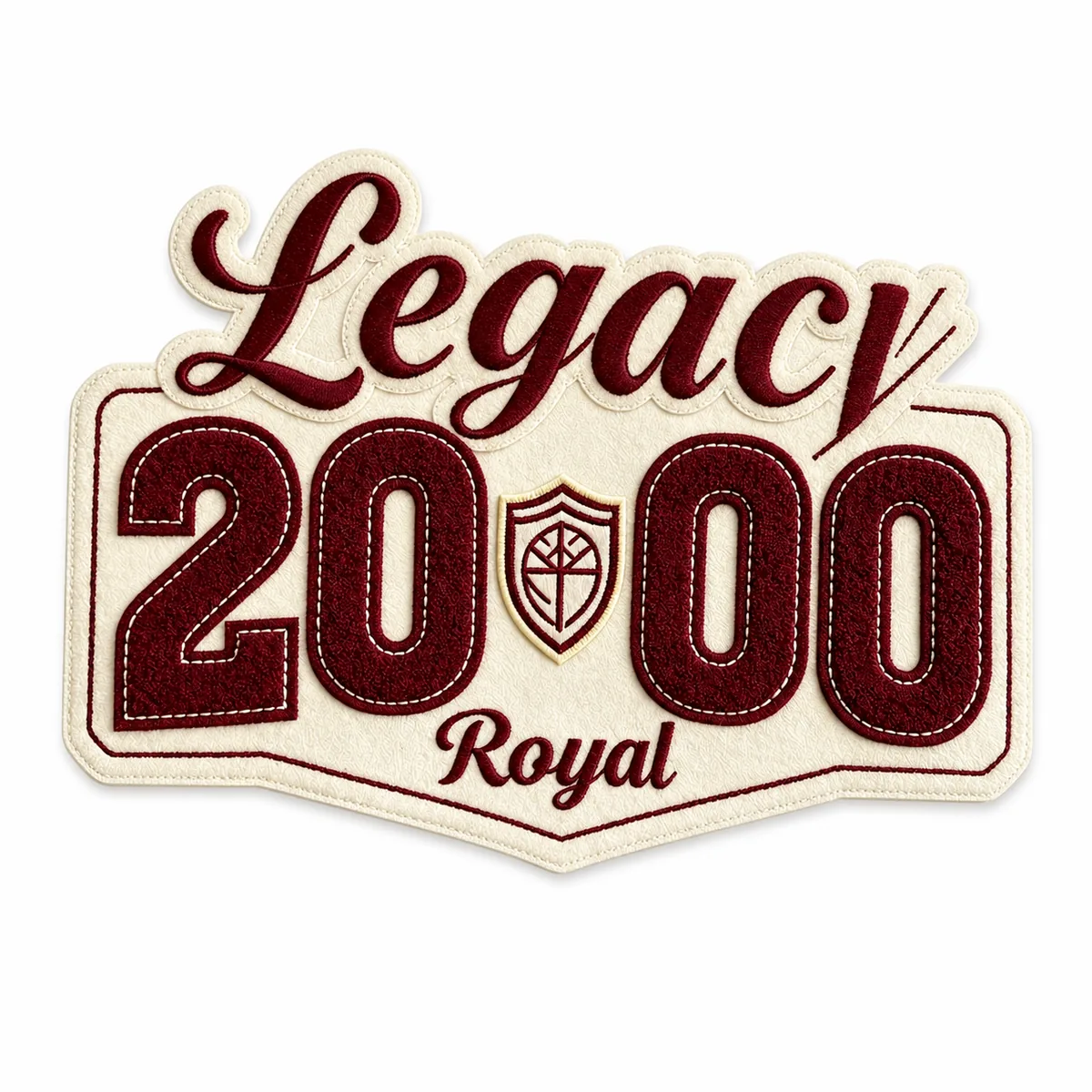
Because loop pile is thick, a chenille patch cannot render anything smaller than a bold stroke — small type simply has nowhere to sit. Because embroidery thread is finer, it can carry lettering and thin outlines, though its own thickness still closes up the smallest type.
Side-by-side comparison
The same table answers the question whether you write it chenille vs embroidered or embroidered vs chenille. The first four rows decide most orders.
| Factor | Chenille patch | Embroidered patch |
|---|---|---|
| Surface | Loop pile — soft, thick, towel-like | Stitched thread on twill — flat to slightly raised |
| How height is made | The yarn loop itself | Thread density and coverage; foam only for 3D puff |
| Smallest element it can hold | Bold strokes only — no small type at all | Moderate lettering and thin outlines |
| Outline quality | Soft, rounded, slightly blurred at the edge | Crisp — stitch direction follows the contour |
| Gradients and shading | Not possible — solid loop colour blocks only | Possible through stitch direction and thread blends |
| Base fabric | Felt | Twill |
| Typical border | Merrow (overlock), standard | Merrow, laser or heat cut |
| Hand feel | Soft and thick, gives under pressure | Firmer and flatter, holds its shape |
| Best known for | Varsity letters, mascots, year patches | Crests, logos, cap fronts, detailed marks |
| Cost driver | Per letter: finished height, loop-colour count, quantity | Stitch count and coverage |
| Order minimum | Same for both: 50 pcs per design | |
| Bulk lead time | Same for both: 3–7 days after proof approval | |
Embroidered vs chenille: does the answer change?
No — the comparison is symmetric, and reversing the wording swaps the columns without moving the decision rule. What does change is the question buyers are usually really asking when they search it this way round: is chenille worth paying for over plain embroidery?
Sometimes yes. If the garment is a letterman jacket and the letters are 15 cm tall, chenille is not an upgrade — it is the only construction that looks right, because embroidery at that size reads as a large flat patch rather than a letter. If the garment is a cap, a polo or a tote and the mark is a logo, chenille adds cost and weight without adding anything the buyer can see.
The honest test is the garment, not the patch. A soft, heavy, unstructured garment carries chenille well. A structured or small-surface item does not.
When chenille wins
- Letterman and varsity jackets. The material convention is fixed: programmes expect loop pile on the chest and back letter. Substituting embroidery is immediately visible to anyone who has bought one before.
- School and club programmes. A full alphabet set cut to one chosen height keeps a graduating class consistent, and the same order can carry mascot and year patches in the same construction.
- Retro and streetwear capsules. Chenille reads as a deliberate period reference on a coach jacket or a cap, in a way a flat patch does not.
- Anything that will be photographed at a distance. Pile catches light and reads as texture from across a room, which is why it survives yearbook and press photography better than flat constructions.
- Wear that involves heavy washing. Chenille is a textile surface rather than a stitched one, so surface abrasion reads as part of the pile instead of as thread damage.
The per-letter price logic and the three letter styles are laid out on the chenille letters page. Programme ordering — sizes, backing, season timing — is covered in the varsity letters guide.
When embroidery wins
- Crests and badges with text. A club crest almost always carries a name, a year or a motto, and each of those is text. Embroidery can hold it; chenille cannot.
- Cap front panels. The panel is small and the mark is usually a wordmark. Embroidery keeps it legible, and 3D puff is available when you want it to stand off the crown.
- Multi-colour logos with thin outlines. Stitch direction follows the contour, so an outline stays an outline instead of blurring into the fill.
- Shading and gradient artwork. Thread changes and stitch direction can taper a colour; loop pile is solid blocks only.
- Thin or structured garments. Embroidery is flatter and firmer, so it does not pull on a lightweight fabric the way a thick pile patch can.
Where each one hits its limit
- Chenille and small text. There is no version of this that works. If the artwork has a tagline, an address, a registration line or a fine ring of lettering, that element has to be dropped, enlarged, or moved to a different construction.
- Chenille and gradients. Loop colour is a physical yarn, so a gradient becomes a series of bands. If the artwork depends on a smooth fade, chenille flattens it.
- Embroidery and very small type. Thread has thickness. Below a certain stroke width the letters close up — the practical answer for a line of fine print is a woven patch, which holds lettering at a fraction of the size.
- Embroidery and heavy coverage on light fabric. Dense stitching makes a patch stiff and relatively heavy, which can pull on drapey or thin material.
- Both, on iron-on backing over coated fabric. Adhesive performance depends on the fabric and the heat, so it is worth a test on an offcut before a bulk run, especially on water-repellent or synthetic shells.
What each one costs
At the 50-piece pilot run both constructions price the same at $0.65 /pc. They separate at volume, because they are priced on different things.
| Chenille | Embroidered | |
|---|---|---|
| Pilot run (50 pcs) | $0.65 /pc | $0.65 /pc |
| Volume production | $0.25–$0.50 /pc typical | $0.19–$0.38 /pc typical |
| Priced by | Finished height per letter, loop-colour count, quantity | Stitch count and stitch coverage |
| What makes it climb | Taller letters and more loop colours | Denser artwork and more thread colours |
Chenille is priced per letter by finished height, loop-colour count and quantity rather than by stitch count, so a 500-piece letter set typically prices lower per piece than a 100-piece run. Embroidery reacts to the artwork instead: the same physical size can cost very differently depending on how dense the design is.
One artwork is enough to get both constructions quoted side by side, and the comparison quote is free.
Sizes: letters vs patches
Chenille is ordered as two different things, and mixing them up is the most common reason a first proof comes back wrong. Letters are cut to a height you specify; patches are cut to a finished shape.
| Item | Typical size | Where it goes |
|---|---|---|
| Varsity letter (small) | 4 in / 10 cm | Shirts, vests, chest placement, junior programmes |
| Varsity letter (standard) | 6 in / 15 cm | The classic letterman jacket chest |
| Varsity letter (large) | 8 in / 20 cm and up | Back lettering, bomber jackets, statement placement |
| Chenille patch | 3–5 in / 8–13 cm | Mascots, sport icons, year patches, club crests |
| Full alphabet set | Chosen height, all 26 letters | School programmes that letter multiple students |
Sizes are cut to spec, so a 5.5-inch letter is as easy as a 6-inch one — the table is a starting point, not a catalogue. Back lettering often runs larger, 8–12 inches, on a bomber or a varsity back.
Choosing by product type
- Letterman and varsity jackets. Chenille for the letters, embroidery for any name tape or crest beside them. Both in one order keeps the colours matched.
- School and club kit. Chenille letters plus a chenille mascot; embroidery where a motto or a founding year has to be readable.
- Caps and headwear. Embroidery, or 3D puff when the mark should stand up. Chenille pile is too soft to hold a clean edge on a curved panel.
- Jeans, denim jackets and bags. Both work; chenille gives a heavier, softer patch, embroidery keeps a sharper graphic.
- Retro and streetwear capsules. Chenille for the period reference, embroidery for the logo lock-up.
Programme-specific specifications — badges, name tapes, varsity letters, backing types — are collected on the school, club and team applications page.
How to brief both in one RFQ
A comparison only means something if both quotes are built from identical information. Send the same files and the same specification, and ask for both constructions priced against each other.
What to include: vector artwork (AI, EPS, PDF or SVG) or a high-resolution image at finished size; the finished width and height in millimetres or inches; quantity per design; preferred border and backing; and where the patch is going. If the artwork carries small text, say which line has to stay readable — that one detail usually settles the construction for you. If it cannot be read in chenille at all, say so up front and ask for the embroidery version of the same artwork.
Custom samples are arranged together with the quote, so artwork, construction, loop colours and backing are confirmed before production. Sample cost and shipping depend on the product and are confirmed in the quote.
FAQ
What is the difference between chenille and embroidered patches?
Chenille tufts loop-pile yarn through a felt base, so the surface is soft, thick and towel-like. Embroidery stitches thread on top of a twill base, so it is flatter and sharper. Chenille is chosen when the material is the point; embroidery when the artwork's detail is the point.
Is chenille more expensive than embroidery?
At the 50-piece pilot run they price the same at $0.65 /pc. At volume embroidered typically runs $0.19 to $0.38 /pc and chenille $0.25 to $0.50 /pc, because chenille is priced per letter by finished height, loop-colour count and quantity rather than by stitch count.
Can chenille patches have small text?
No. Loop pile is a thick yarn surface, so anything smaller than a bold stroke has nowhere to sit. If your artwork carries a tagline, an address or a fine ring of lettering, that element has to be dropped, enlarged, or moved to embroidery or a woven patch.
Which is better for a varsity letter jacket?
Chenille. Loop pile is the material convention for the chest letter and the back letter, and a programme buyer will recognise embroidery in its place immediately. A 6 in / 15 cm letter is the standard chest size; 8 in / 20 cm and up is used for back lettering.
Can I mix chenille and embroidery in the same order?
Yes, and it is common on school programmes: chenille letters and a chenille mascot, with an embroidered name tape or motto beside them. Ordering both together means the colours are matched and the two constructions arrive on the same schedule.
Do chenille and embroidered patches have the same minimum?
Yes. Both run on the same 50 pcs per design minimum and the same 3-7 day bulk window after proof approval, so the construction you choose does not change your MOQ or your lead time.
What is a 3D puff patch, and is it chenille?
No. 3D puff is embroidery with a foam layer under the stitching, which makes the shape sit up off the base. Chenille gets its height from loop pile instead. Both are raised, which is why "3D patch" is ambiguous — worth naming the construction you actually want.
Which lasts longer, chenille or embroidery?
Both survive normal garment life when sewn on. Chenille wears as a textile surface, so abrasion reads as part of the pile; embroidery hides light surface scuffing in its stitch texture but can lose definition on thread that frays. Iron-on backing is the real variable for either.
Related reading: Custom chenille patches · Custom chenille letters · Custom embroidery patches · Woven vs embroidered patches · Varsity letters guide · Patch backing guide
Price both constructions with one artwork
SAIM Label tufts and embroiders in the same factory — the comparison quote is free.