Woven vs Printed Labels: Which Should You Order?
Short answer: this is three routes, not two. A woven label is damask, satin or taffeta where your artwork is the weave — it is cut and sewn in like a label, and it is the only one of the three that feels like fabric. A printed label is ink on satin polyester, nylon taffeta or cotton — also cut and sewn in, with far finer detail and gradients than weaving allows. A heat transfer label is ink applied straight onto the garment with heat, so there is no seam and nothing to cut out at all. Choose woven for a premium sewn-in brand mark, printed when the artwork is photographic or multi-language, heat transfer when the neckline should feel like nothing is there. All three run on the same 50 pcs per design minimum.
- Quick answer: which one should you order?
- What "printed label" actually means
- Side-by-side comparison
- Printed vs woven: does the answer change?
- When woven wins
- When printed wins
- When heat transfer wins
- Where each one hits its limit
- What each one costs
- Wash and wear
- How to brief all three in one RFQ
- FAQ
Quick answer: which one should you order?
If you only read one part of this page, read this table. Everything below explains the reasoning behind it.
| If your label has to… | Order | Because |
|---|---|---|
| Feel like fabric against the skin | Woven | The label is the textile — the artwork is interlaced yarn, not ink on top of it |
| Carry a logo with gradients, shading or a photograph | Printed | Ink reproduces smooth tonal transitions; weaving resolves the artwork into yarn colour blocks |
| Carry four or five languages of care text | Printed | Small type set at high resolution stays legible; woven lettering closes up as it shrinks |
| Disappear entirely at the neckline | Heat transfer | Applied directly to the fabric — no edge, no seam, no label to cut out |
| Hold a fold: end fold, centre fold, miter or loop | Woven or printed | Both are cut and sewn, so both take a fold; a heat transfer is flat by nature |
| Survive industrial laundering and repeated wash | Woven | Yarn does not crack or lift; ink adhesion is the variable for either printed route |
| Sit on a coated, water-repellent or high-loft fabric | Woven | Heat application is unreliable on surfaces that resist bonding or trap air |
| Brand kit for kidswear where the neck must not itch | Heat transfer | Nothing is sewn at the nape, so there is no scratch point at all |
The rule of thumb: decide how the label gets onto the garment before you decide how it is made. Sewn-in narrows you to woven or printed; applied-by-heat means heat transfer. After that the question is only whether the artwork needs ink's tonal range or yarn's hand feel.
All three are made in the same factory here, so one RFQ can price them against each other: send one artwork and get all three quoted.
What "printed label" actually means
Most comparisons of woven versus printed labels skip this, and it is the reason buyers end up with the wrong product. "Printed" describes a marking method, not a product. There are two different things sold under that word, and they behave nothing like each other.
Printed and sewn in. Ink is printed onto a roll of satin polyester, nylon taffeta or cotton, then cut and folded like a woven label. It is a real label with an edge, a fold and a seam allowance, and it goes into the garment the same way a woven one does. This is the standard route for care and composition labels, where the text changes per market and has to be legible at a few millimetres.
Printed and heat applied. Ink is printed onto a carrier sheet or roll, then transferred onto the garment with a heat press. There is no label afterwards — only a printed mark on the fabric itself. Nothing is sewn, nothing has an edge, and there is nothing to cut out of a neckline. This is the tagless route.
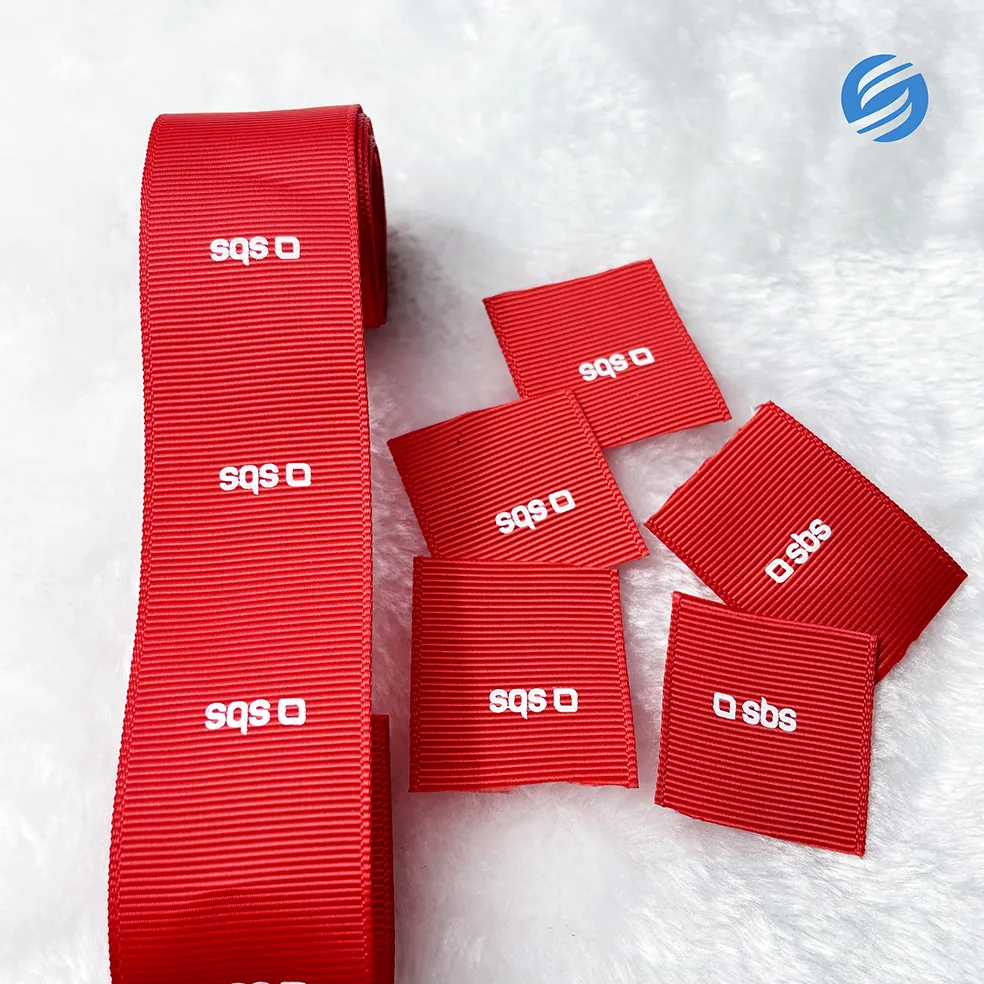
So when a supplier says "printed labels are cheaper", ask which of the two they mean and at what quantity. The two sit at different price points at volume, and only one of them can take a fold.
Side-by-side comparison
The first five rows decide most orders.
| Factor | Woven label | Printed, sewn in | Printed, heat applied |
|---|---|---|---|
| How it is made | Artwork interlaced as yarn on a loom | Ink printed onto satin, nylon or cotton | Ink transferred onto the garment with heat |
| Hand feel | Fabric — soft, textured, premium | Fabric base with a smooth printed surface | Barely there; follows the fabric |
| Colour range | Yarn colour blocks; fine shading is limited | Gradients and photographic tone | Gradients and photographic tone |
| Smallest legible type | Fine, but closes up as the label shrinks | The finest of the three | The finest of the three |
| Fold options | End, centre, miter, loop | End, centre, miter, loop | None — it is flat by nature |
| Attachment | Sewn into a seam | Sewn into a seam | Heat press, no seam |
| Edge | Ultrasonic sealed or woven selvedge | Cut and sealed | No edge at all |
| Best known for | Brand marks, neck labels, size tabs | Care labels, multi-language text, complex logos | Tagless necks, kidswear, performance wear |
| Fails on | Photographic artwork, tiny multi-language blocks | Very high wash temperatures, harsh solvents | Coated and water-repellent shells, high-loft fleece |
| Order minimum | Same for all three: 50 pcs per design | ||
Printed vs woven: does the answer change?
No — reversing the wording swaps the columns without moving the decision rule. What changes is the starting assumption. Buyers who search printed vs woven labels usually already have a printed label in hand and are wondering whether woven is worth the upgrade.
Sometimes it is, and the test is simple. If the label is the brand mark — the thing a customer sees when they turn the garment inside out — woven is worth it, because the fabric hand feel is part of what they are judging. If the label is compliance furniture, a care and composition block that has to carry the same information in four languages, printed is the correct answer and woven is paying for a texture nobody reads.
Plenty of programmes use both: woven for the neck brand label, printed for the care label beside it. That is a normal split, not a compromise.
When woven wins
- The label is the brand moment. A woven neck label is the one trim a customer physically touches when they check what they bought. Yarn reads as considered in a way ink on satin does not.
- It will be washed hard. Interlaced yarn has no ink layer to crack, lift or fade, so the label outlasts the print in heavy-wear programmes.
- You need a fold and a specific reveal. End fold, centre fold, miter fold and loop are all standard, and the fold guide covers what each one shows on the garment.
- The garment is a premium or heritage line. Damask and satin carry a perceived value that printed satin does not, at a per-piece cost that is still measured in cents.
- You want a size tab or a flag label that keeps its shape. Woven holds a crisp edge through washing where a printed edge can soften.
Constructions, fold options and standard dimensions are laid out on the woven labels page and the size guide.
When printed wins
- Care and composition text. The wording changes per market and has to stay readable at a few millimetres. Printed holds that; woven lettering closes up as the label gets smaller.
- Multi-language blocks. Four or five languages on one small label is a print job, not a weaving job.
- Gradients, shading and photographic artwork. Ink reproduces tonal transitions that yarn can only approximate as bands of colour.
- Barcode and QR codes. A printed label can carry a scannable code at a size that survives handling; the same code in weave is unreliable at small scale.
- A brand mark that has to match a printed look elsewhere. If the packaging and the hang tag are printed, a printed label keeps the colour identical across the set.
Wording requirements per market — what the US and the EU each ask for — are set out in the care label requirements checklist.
When heat transfer wins
- Tagless necklines. Nothing is sewn at the nape, so there is no scratch point — the single most common comfort complaint about sewn labels.
- Kidswear and next-to-skin. The same reasoning, and it removes the loose-label risk that soft goods programmes watch for.
- Performance and base layers. A printed mark does not add bulk or stiffness where the garment has to stretch and recover.
- Garments where a seam cannot be added. Bonded, seamless or laser-cut constructions have nowhere to sew a label into.
- Short-run colour changes. Nothing is cut or folded, so a colourway change is a print change.
The trade-off is application, not manufacture. Heat transfers are supplied as sheets or rolls with settings, and the result depends on the press, the temperature and the fabric. On coated, water-repellent or high-loft surfaces the bond is the risk, so it is worth a test on an offcut before a bulk run.
Where each one hits its limit
- Woven and photographic artwork. A weave resolves the image into yarn colour blocks. Fine gradients band, and a detailed illustration loses its mid-tones.
- Woven and very small multi-language text. The label can only hold so many yarn picks per centimetre. Below a certain type size the letters fill in.
- Printed and aggressive washing. Ink adhesion is the variable, not the base fabric. High-temperature industrial laundering and harsh solvents are where printed labels fail first — confirm the wash regime when you brief.
- Heat transfer and difficult surfaces. Coated shells, water-repellent finishes and high-loft fleece resist a reliable bond. A transfer that looks perfect on a cotton jersey can lift at the corner on a coated nylon.
- All three and unknown artwork scale. The cheapest mistake in this category is approving artwork at the wrong finished size. Set the label dimensions in millimetres or inches before anything else.
What each one costs
At the 50-piece pilot run all three start at $0.20 /pc. They separate at volume, and the gap between woven and printed is smaller than most buyers expect.
| Woven | Printed, sewn in | Heat transfer | |
|---|---|---|---|
| Pilot run (50 pcs) | $0.20 /pc | $0.20 /pc | $0.20 /pc |
| Volume production | $0.03–$0.15 /pc typical | $0.04–$0.15 /pc typical | $0.05–$0.20 /pc typical |
| Catalog designs | 121 | 36 | 15 |
| Priced by | Size, yarn count, fold, quantity | Size, colour count, quantity | Size, colour count, quantity, carrier format |
Volume price is driven by size and quantity more than by which of the three you pick, so the construction decision should be made on function first. A quote confirms the number for your actual size and run.
Wash and wear
All three are built for normal garment life, and the differences show at the extremes rather than in the middle.
- Woven. Interlaced yarn has no applied ink layer, so there is nothing to crack or peel. Repeated washing softens the hand slightly but does not remove colour.
- Printed, sewn in. The label survives as a label; the question is ink adhesion on the base. Standard home washing is routine; the risk is high-temperature industrial laundering and solvent exposure.
- Heat transfer. Performance depends on the press settings and the fabric more than on the print. Correctly applied on a suitable fabric it outlasts the garment; incorrectly applied it lifts at an edge within a few washes.
- Edges. Woven and printed labels both rely on a sealed cut edge to stop fraying. Ultrasonic sealing is standard here, and woven labels are held to a ±2 mm finished-size tolerance against the approved proof.
How to brief all three in one RFQ
A comparison only means what it compares. Send the same files and the same specification, say how the label is attached, and ask for the routes priced against each other.
What to include: vector artwork (AI, EPS, PDF or SVG) or a high-resolution image at finished size; finished width and height in millimetres or inches; quantity per design; preferred fold; where the label sits on the garment; the wash regime it has to survive; and any market-specific wording. If the label is a care label, attach the exact text — the wording is the specification.
Custom samples are arranged together with the quote, so artwork, base fabric, fold and colour are confirmed before production. Sample cost and shipping depend on the product and are confirmed in the quote.
FAQ
What is the difference between woven and printed labels?
A woven label interlaces your artwork as yarn, so the design is the fabric itself. A printed label lays ink onto a base such as satin polyester, nylon taffeta or cotton. Woven wins on hand feel and wash durability; printed wins on fine detail, gradients and multi-language text.
Are printed labels cheaper than woven labels?
At volume they are close: woven typically runs $0.03 to $0.15 /pc and printed-and-sewn $0.04 to $0.15 /pc. Both start at $0.20 /pc for the 50-piece pilot run. Heat transfer runs $0.05 to $0.20 /pc at volume. The construction decision should be made on function, not on a few cents.
Is a heat transfer label the same as a printed label?
No. Printed-and-sewn labels are cut and sewn into a seam like a woven one, with an edge and a fold. A heat transfer is printed onto a carrier and applied straight to the garment with heat, so there is no label afterwards — only a printed mark on the fabric.
Which label type is best for kidswear?
Heat transfer, if the goal is a neckline with nothing sewn at the nape — there is no edge and no scratch point. If the programme requires a sewn brand label, woven with an ultrasonically sealed edge is the softer choice.
Can a printed label carry a QR code or barcode?
Yes, and that is one of the reasons printed is standard for care and composition labels. A printed code stays scannable at small sizes; the same code rendered in weave is unreliable at that scale.
Do all three have the same minimum order?
Yes. Woven, printed-and-sewn and heat transfer all run on 50 pcs per design, so the construction you choose does not change your MOQ.
Which one lasts longest in the wash?
Woven, because there is no applied ink layer to crack or lift. Printed labels are routine for normal home washing but are the first to show wear under high-temperature industrial laundering or solvent exposure. Heat transfer performance depends most on how well it was applied to that specific fabric.
Can I mix woven and printed labels in one order?
Yes, and it is the most common programme structure: a woven brand label at the neck with a printed care and composition label beside it. Ordering both together keeps the colours matched and puts them on one production schedule.
Related reading: Custom woven labels · Custom care labels · Heat transfer labels and tagless prints · Standard woven label sizes · Woven label folds · Care label requirements: US and EU
Price all three routes with one artwork
Woven, printed and heat transfer are all made in the same factory — the comparison quote is free.